Radon in the home: the invisible danger and how to protect yourself.
How to protect your family whilst saving energy – a concise guide.
Radon is a naturally occurring, radioactive gas that seeps invisibly into homes and can cause lung cancer. Decentralised ventilation systems offer effective, controlled protection by continuously diluting and extracting the gas before it becomes dangerous.

Why is radon so dangerous?
Radon in residential buildings is not a niche problem. This odourless, tasteless and invisible noble gas is produced by the natural decay of uranium in the ground. It can enter residential buildings unnoticed through foundations, cracks in basement walls and cable penetrations, where it can accumulate.
The World Health Organisation (WHO) and the Federal Office for Radiation Protection (BfS) warn that radon is the second most common cause of lung cancer in Germany after smoking. The concentration depends heavily on the geology (GEO factor) and the airtightness of your building. Modern houses are often so well insulated that radon can accumulate more quickly. The solution is a well-designed ventilation system.
How high is the radon risk where you live?
Find out what the estimated geological radon levels are at locations throughout Germany.
LUNOS Radon Risk Check
Check the geological radon risk at your home and find the right ventilation solution.
How can you protect yourself from radon?
As an initial emergency measure in the event of elevated radon concentrations, intensive cross-ventilation and intermittent airing help to remove the gas from the rooms in the short term. In addition, connecting doors to the cellar should always remain closed to prevent radon-containing air from the basement from being drawn into the upper living areas via the so-called chimney effect.
“If there is too much radon in the house, regular and thorough ventilation is a good first step.”
In addition to sealing pipe penetrations and the targeted extraction of ground air, continuous, controlled air exchange is the most effective measure for sustainably reducing radon levels in buildings.
Decentralised ventilation systems specifically extract radon-containing indoor air to the outside and supply fresh, filtered outdoor air. The principle of positive pressure ventilation is particularly effective here: by supplying the room with a minimal amount more fresh air than is extracted, a slight, barely perceptible positive pressure is created. This actively prevents further radon gas from being drawn up from the ground through fine cracks in the foundations. This constant minimum air exchange reliably prevents the build-up of radon and dilutes the gas to well below critical thresholds – thanks to integrated heat recovery, this is fully automatic, energy-efficient and without any heat loss, unlike manual window ventilation.
Statutory regulations on protection against radon
In accordance with the Radiation Protection Act, the federal states have designated areas where elevated radon concentrations are to be expected. Depending on the type of building, the following requirements apply in these areas:
- Existing residential buildings: Owners and occupants may take measures to reduce radon concentrations on a voluntary basis.
- New buildings: Builders are legally obliged to prevent radon ingress as far as possible through specific structural measures.
- Workplaces: Measurement is mandatory here. If the reference value of 300 becquerels per cubic metre is exceeded, measures to reduce levels must be taken.
The best solution in a direct comparison.
Here we compare the most common ventilation strategies in terms of their suitability for reducing radon.
| Window ventilation | Exhaust ventilation system (bathroom) | Central ventilation (heat recovery) |
Decentralised ventilation (LUNOS) |
|
|---|---|---|---|---|
| Radon dilution | ✘Low & Unreliable | Medium (only in certain places) | ✔Very good | ✔Very good & Well-controlled |
| Energy efficiency | ✘Very low (Heat loss) | Medium | ✔Very good | ✔Very good |
| Installation effort | ✔Minimal | ✔Low | ✘High (Pipework) | ✔Low (ideal for refurbishment) |
| Comfort (draughts/noise) | ✘minimal (draughts/noise) | ✘minimal (draughts/noise) | Good | ✔Very good (quiet, comfortable) |
| GEO suitability (prevention areas) | ✘Insufficient | Conditional (only with a supply air system) | ✔Very good | ✔ Excellent |
LUNOS systems: A smart choice!
Guaranteed cross-ventilation effect
Our systems operate in pairs and ensure a continuous, controlled air exchange throughout the living space. Radon is effectively diluted and removed.
No risk of negative pressure
By intelligently balancing the supply and extract air, we prevent negative pressure from developing in the living space, which would otherwise ‘draw’ additional radon up from the cellar.
High heat recovery
You save on heating costs, even when the ventilation system is running round the clock.
Easy retrofitting
Ideal for existing buildings and basements, as no pipework needs to be laid.
Whisper-quiet operation
You can enjoy fresh air without any disturbing noise.
← Swipe or scroll to explore →
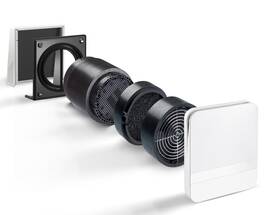
Ideal for holistic living spaces.
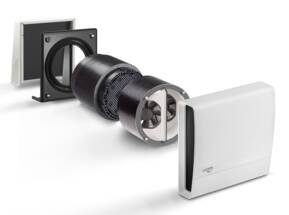
For individual rooms and the basement.
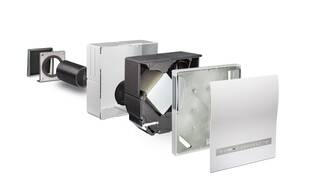
Heavy loads and basements.
Frequently asked questions about radon and ventilation
Radon precautionary areas are regions defined by law where, due to geological conditions, an elevated concentration of radon is expected in the soil air (GEO factor). Such designated areas exist in Germany, Austria and Switzerland (e.g. low mountain ranges). If your building is located in such an area, the requirements for radon protection are stricter, particularly for new buildings and workplaces. However, radon can also occur in unacceptable levels outside these areas. A measurement is the only way to be certain.
As radon escapes from the ground, basements and the ground floor are the most affected. It diffuses into the building through foundations, cracks in floor slabs, joints, cable penetrations or leaky basement walls. From there, it can also spread to upper floors via the ‘chimney effect’ (warm air rises).
The simplest and most reliable method is a long-term measurement using so-called passive dosimeters. These are small plastic containers which you place in the most frequently used rooms (e.g. living room, bedroom) and in the cellar for several months (ideally throughout the winter heating season). The results are analysed anonymously in an accredited specialist laboratory.
In Germany, the statutory reference value is 300 becquerels per cubic metre (Bq/m³) as an annual average for living spaces and workplaces. However, the World Health Organisation (WHO) recommends aiming for a target level of 100 Bq/m³ as a precautionary health measure. Any level below this further minimises the health risk.
Thorough airing helps to reduce the concentration temporarily. However, to keep radon levels below the reference value in the long term, ventilating by opening windows is too unreliable and inefficient. As soon as the windows are closed, the gas builds up again. Furthermore, in winter, a huge amount of heating energy is lost, which runs counter to the energy efficiency of modern buildings. Controlled ventilation is essential.
Modern or refurbished buildings are constructed to be airtight in order to save energy. However, without a controlled ventilation system, natural air exchange is prevented. Radioactive radon, which enters unnoticed, can no longer escape and accumulates in living spaces – airtight houses trap the hazard.
Our decentralised ventilation systems operate in balanced mode (cross-ventilation). They are designed to precisely balance the volumes of supply and extract air. This prevents a permanent negative pressure from developing in the living space, which, like a vacuum cleaner, would draw additional radon from the cellar or the ground into the house. A slight positive pressure in the cellar area is actually beneficial.
Yes, absolutely. Cellars are the main entry points. Controlled, decentralised cellar ventilation with heat recovery is a very effective measure that is easy to retrofit. It dilutes the gas directly at the source and extracts it before it spreads throughout the rest of the house. It also protects the basement from damp and mould.
Our modern LUNOS control systems can be fitted with sensors (e.g. CO₂ or humidity sensors). These monitor air quality indirectly. Although they do not measure radon directly, demand-controlled ventilation – which responds to the presence of people or humidity – automatically ensures increased air exchange when the air is ‘stale’. This helps to regulate radon concentrations reliably, even without a dedicated radon sensor.
Advice and Contact
From radon prevention in new builds to refurbishment of existing properties: we offer expert support in drawing up a ventilation concept in accordance with DIN 1946-6 and in selecting suitable ventilation units.”
Personal consultation
Support from LUNOS experts regarding DIN 1946-6 and equipment selection.
Design yourself
Download: Design tool for independent planning.
- Why is radon so dangerous?
- How can you protect yourself?
- Comparison of the best solutions
- Frequently asked questions (FAQ)
- Service & Help
Please contact us at:
Tel.: +49 30 362 001-0
E-Mail: info@lunos.de
